Skip to product information
1 of 6

Mimaki

Mimaki TXF300-75 DTF Printer

Mimaki TXF300-75 DTF Printer

Regular price $9,995.00
Regular price $15,995.00 Sale price $9,995.00
Sale Sold out
Shipping calculated at checkout.

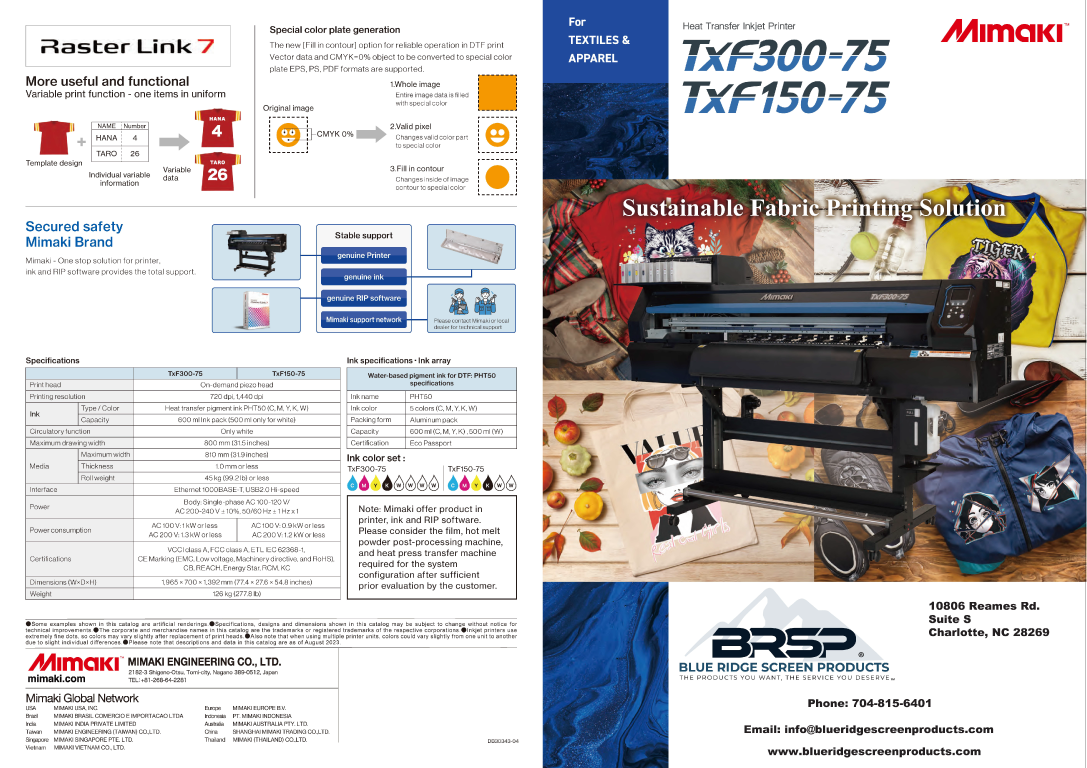
Experience unmatched speed, reliability, and print quality with the Mimaki TxF300-75 DTF Printer—a next-level solution for high-volume DTF printing. Built for demanding production environments, the TxF300-75 combines Mimaki’s precision engineering with innovative technology to deliver fast, consistent, and vibrant DTF transfers. Whether you're scaling up your garment business or upgrading to a more stable system, this printer stands out in the crowded field of DTF printers with advanced features that reduce downtime and improve efficiency.

Key Benefits:

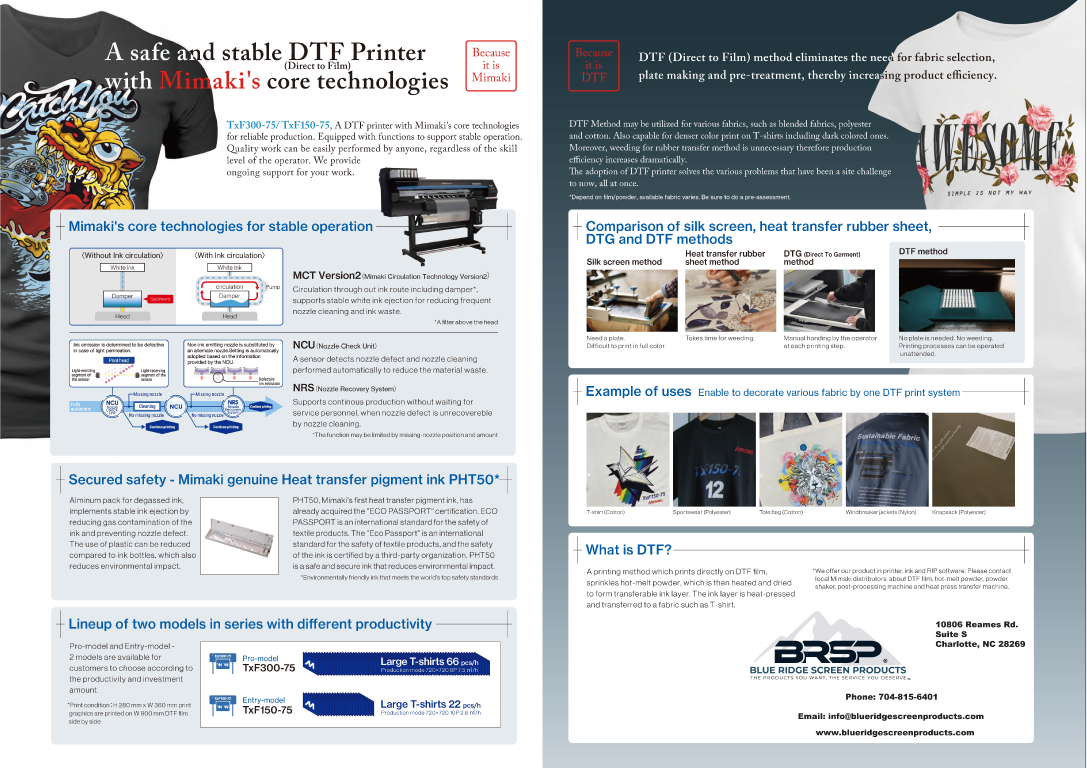
  • Safe and Stable Performance: Engineered to reduce common DTF printing issues like ink clogging and banding for smooth, continuous production.
  • NCU & NRS Technology: Mimaki’s Nozzle Check Unit and Nozzle Recovery System automatically detect and compensate for missing nozzles, minimizing downtime and wasted media.
  • Degassed Inks: Prevents bubbles and ink flow interruptions, ensuring consistent printhead performance and sharp transfer output.
  • MCTv2 White Ink Circulation System: Mimaki Circulation Technology keeps white ink flowing, preventing settling and improving print stability for opaque and vibrant prints.
  • OEKO-TEX® Certified Inks: Environmentally safe and garment-friendly inks that meet global safety standards for apparel production.

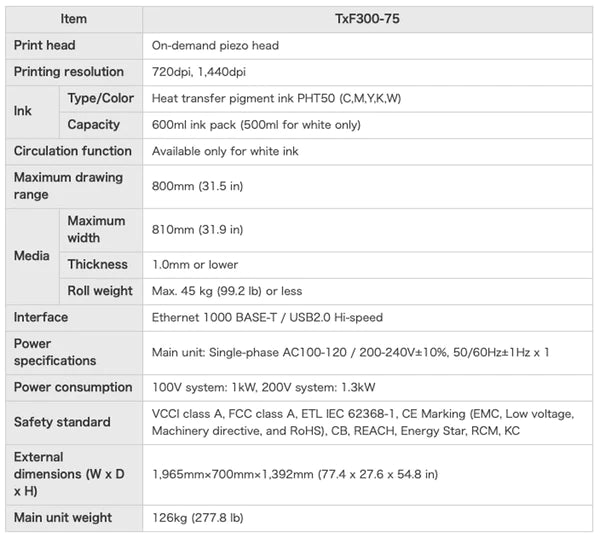
The Mimaki TxF300-75 DTF Printer is ideal for print shops, custom apparel brands, and decorators looking to expand into or scale up DTF printing. With its wide 31.5” format and high-speed output, it’s perfect for pairing with automated powder shakers and curing units in a professional production line. Simply load your film, print vivid transfers with high ink density, and apply them to a wide range of textiles. This printer is the smart choice for businesses that need industrial performance without compromising on print quality or reliability.


Included with the Mimaki TXF300-75 Printer:

  • 1-Year Complete Coverage Warranty* - Includes printheads and onsite support if needed. *Head strikes are not covered under warranty. See Mimaki Warranty for details
View full details

Maintenance tips

Watch these helpful videos from Blue Ridge University to keep your Mimaki TxF300 running smoothly

Cap Head, Wiper, and Sponge Pad Replacement

Learn how to replace the cap head assembly, sponge pad, and wiper on a Mimaki TxF300 DTF printer. This step-by-step video covers entering maintenance mode, removing the worn components, installing the replacement parts, and confirming each part is positioned correctly.

White Damper Replacement

Follow along as we demonstrate how to replace a white ink damper on the Mimaki TxF300 DTF printer. This video walks through accessing the damper, safely removing the old component, installing the replacement, and preparing the printer to return to operation.

Frequently Asked Questions

How often does a DTF printer need maintenance?

DTF printers require routine maintenance because white pigment can settle and ink can dry around the printhead, cap station, wiper, and ink-delivery components.

Both Mimaki and DCC DTF printers have systems that notify users when maintenance needs done and provides instructions that are simple and easy to follow.

Maintenance may include:

  • Nozzle checks
  • Printhead cleaning
  • Cap and wiper inspection
  • White ink circulation
  • Agitating white ink
  • Cleaning around the printhead
  • Replacing dampers, filters, caps, or wipers when necessary

Visit Blue Ridge University for educational maintenance resources.

Should I choose a DCC NeoFlex or a Mimaki DTF printer?

The DCC NeoFlex provides several configurations for shops building an in-house DTF production workflow. It can be a good fit for businesses that want a very fast and all-in-one printing, shaking, and drying system with options based on output and color requirements.

Mimaki DTF printers are systems that emphasize easy operation, white ink management, maintenance features, and consistent printing.

The right system depends on your volume, budget, staffing, maintenance expectations, and long-term production plans.

What is the difference between the Mimaki TxF300-75 and TxF330-800?

The primary difference is production capability. The Mimaki TxF300-75 is a proven professional DTF printer designed for shops that need dependable daily production, integrated white ink management, and manufacturer-supported maintenance features.

The Mimaki TxF330-800 builds on that platform with Mimaki’s newer 330-series print technology. It is designed for higher-volume production and offers increased print speed, expanded ink-configuration options, and additional ink capacity for longer uninterrupted print runs.

Key differences include:

  • Production speed: The TxF330-800 is designed to produce transfers faster than the TxF300-75.
  • Ink configurations: The TxF300 uses a standard CMYK-plus-white configuration. The TxF330-800 offers options focused on either maximum productivity or an expanded color gamut.
  • Continuous production: The TxF330-800 provides greater ink capacity and uninterrupted ink-supply features for longer production runs.
  • Color reproduction: Expanded-color configurations on the TxF330-800 can produce smoother gradients, improved skin tones, and a wider range of colors.
  • Best application: The TxF300 is a strong fit for shops building or expanding professional DTF production. The TxF330-800 is better suited for high-volume transfer producers and businesses that need greater throughput.

Both printers include Mimaki technologies designed to manage white ink, monitor nozzle performance, and support consistent DTF production. The right choice depends on your current order volume, expected growth, desired color capability, and daily operating schedule.

Contact our DTF equipment specialists to compare the two printers based on your expected production volume.

What is the difference between an entry-level and production DTF system?

Entry-level systems generally have a lower initial investment and may be appropriate for shops bringing transfer production in-house for the first time.

Production systems are designed around higher output, longer operating schedules, greater automation, manufacturer-supported components, and features that help improve consistency and maintenance.

Purchase based on expected daily volume and support needs rather than price alone.

What size DTF printer should I buy?

Choose a printer based on transfer volume, typical artwork size, available floor space, labor, budget, and expected growth.

Our recommendation is a 32-inch system such as the Mimaki TxF300-75 or Mimaki TxF330-800.

What fabrics can be decorated with DTF transfers?

DTF transfers are commonly applied to cotton, polyester, and blended garments. They can also be used on many other compatible textiles and products that can withstand the required heat and pressure.

Always test unfamiliar, coated, heat-sensitive, or heavily dyed materials before production.

What products are needed for a complete DTF printing system?

A complete DTF workflow generally includes:

Blue Ridge can help configure a complete system so the printer, shaker, consumables, ventilation, and heat press work together.

What is DTF printing?

Direct-to-film, or DTF, is a garment-decoration process in which a design is printed onto coated film, covered with adhesive powder, cured, and transferred to a garment with a heat press.

DTF can be used for full-color designs and does not require a separate screen for each color. Explore our selection of DTF printers.

What type of heat press is best for DTF transfers?

A heat press for DTF transfers should provide consistent temperature, even pressure, and a platen large enough for your typical designs. A 16-by-20-inch press is a popular size because it accommodates many full-front and full-back garment designs.

Higher-volume shops may benefit from a pneumatic or dual-station press that allows one garment to be prepared while another is being pressed.

Browse our commercial heat presses.

Should I choose a 24" or 32" DTF film?

Choose a film width that matches the usable print width of your DTF printer and shaker.

Printers such as the Mimaki TxF300-75 or Mimaki TxF330-800 can print on either 24" or 32" film. 32" film is a great choice for getting the most bang for your buck when it comes to printing.

What is DTF transfer powder?

DTF transfer powder is a heat-activated adhesive used during the direct-to-film printing process. After a design is printed onto DTF film, the powder is applied to the wet ink. Once cured, the powder creates the adhesive layer that bonds the printed design to the garment during heat pressing.

What is DTF film?

DTF film is a coated carrier film used to receive a printed DTF design before it is transferred to a garment. The printer deposits color and white ink onto the film, DTF transfer powder is applied to the wet ink, and the transfer is then cured and pressed onto the garment.

Shop our available DTF film rolls and sheets.

  • Need Assistance with Mimaki Products?

    Our team is committed to your success and satisfaction. We are passionate about helping the printing community through knowledge, education, and service. Need additional information on our products, contact us today and we will be happy to assist!